The Simpsons database consists of 4 main tables: characters, episodes, locations and script_lines. The script_line table has following fields: id (primary key), episode_id (foreign key), number, character_id (foreign key), location_id (foreign key), raw_text and normalized_text.
Problem 1
Problem Description
In what season/episode does Homer utter his 100th, 200th, and 300th “d’oh”?
-
Be sure to only include instances of “d’oh” linked to Homer’s character_id=2.
-
Be aware that a record in the “script_lines” table can contain multiple instances of “d’oh” and we want to count all of them. For instance, if Homer says “d’oh, d’oh, d’oh” in one “script_lines” record then that counts as 3 “d’oh,” not 1.
-
Count all instances of the substring ‘annoyed grunt’ in the “raw_text” field AND all instances of the substring ‘doh’ in the “normalized_text” string (recall that ‘annoyed grunt’ in the “raw_text” field represents a ‘doh’).
-
For example, If a record has 1 instance of ‘annoyed grunt’ in “raw_text” and 1 instance of ‘doh’ in “normalized_text” then that record counts as 2 total.
-
Output should include the season, episode number within the season, episode title, location, and ‘doh counter’ for each of the 100th, 200th, and 300th occurrences.
Query
WITH tab1 AS
	(
	SELECT	id,
		episode_id,
		number,
		character_id,
		location_id,
		ROUND((LENGTH(LOWER(raw_text)) -
			LENGTH(REPLACE(LOWER(raw_text),'annoyed grunt',''))
			)
			/
			LENGTH('annoyed grunt')
			) AS count_ag,
		COALESCE(ROUND((LENGTH(LOWER(normalized_text)) -
				LENGTH(REPLACE(LOWER(normalized_text),'doh',''))
				)
				/
				LENGTH('doh')
			),0) AS count_doh
	FROM	script_lines
	WHERE	(raw_text LIKE '%annoyed grunt%' OR
		normalized_text LIKE 'doh %' OR
		normalized_text LIKE '% doh %' OR
		normalized_text LIKE '% doh') AND
		character_id = 2
	),
tab2 AS
	(
	SELECT	*,
		count_ag + count_doh AS doh_total
	FROM	tab1
	),
tab3 AS
	(
	SELECT	*,
		SUM(doh_total) OVER(ORDER BY episode_id, number) AS doh_sum
	FROM	tab2
	)
SELECT		episodes.season AS Season,
		episodes.number_in_season AS Episode,
        	episodes.title AS Title,
        	locations.name AS Location,
        	doh_sum
FROM		tab3
INNER JOIN	episodes
ON		tab3.episode_id = episodes.id
INNER JOIN	locations
ON		tab3.location_id = locations.id
WHERE		doh_sum = 100 OR
		doh_sum = 200 OR
		doh_sum = 300;
Output
| Season | Episode | Title | Location | doh_sum |
|---|---|---|---|---|
| 3 | 24 | Brother, Can You Spare Two Dimes? | Simpson Home | 100 |
| 7 | 13 | Two Bad Neighbors | Simpson Home | 200 |
| 14 | 17 | Three Guys of the Condo | Apartment | 300 |
Problem 2
Problem Description
Barney Gumble (character_id = 18) is a funny character on the show who is likely Homer Simpson’s best friend. Some have argued that Barney “always seems to be stuck in Homer’s shadow” and should be given more “airtime” independent of Homer. We will investigate this claim. Specifically, we want to count the number of Barney’s “appearances” with and without Homer (character_id = 2).
- A “Barney appearance” will not simply be defined as a record in “script_lines” with character_id=18 - if he has multiple lines in an episode that are relatively close to one another we want consider those lines as being part of the same “appearance.”
- Specifically, order the script_lines data by “episode_id” and then by “number” and consider each episode separately in the calculations.
- First, find all records credited to Barney (character_id = 18), including speaking and non-speaking lines (in what is shown below I denote this with “barney_ind”).
- Then, consider a “Barney appearance” to consist of the 3 records before the first instance of barney_ind = 1, the 3 records after the last instance of barney_ind = 1, and all records in-between as long as there is no gap of 6 consecutive records or more that are not credited to Barney.
- Examples:
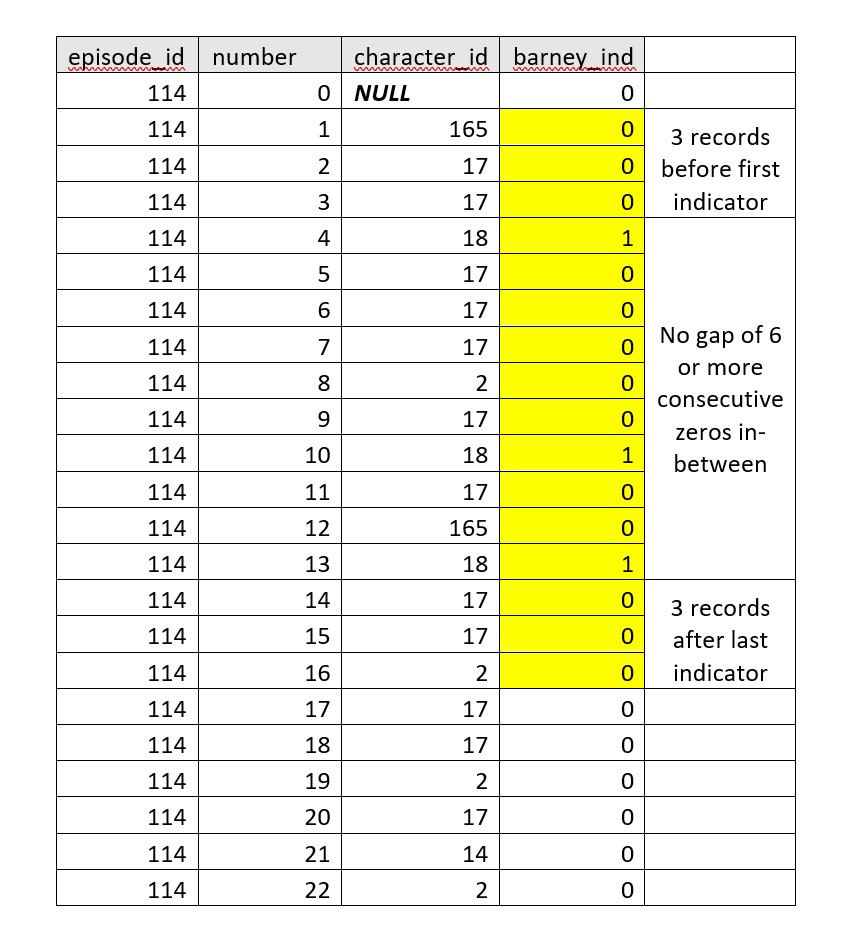
The above yellow block of records would define 1 “Barney appearance.” It consists of the 3 records before the first “barney_ind,” the 3 records after the last “barney_ind,” and there is no gap of 6 or more consecutive records with “barney_ind” = 0 in between. Also note that since there is at least 1 instance of character_id = 2 (Homer) in this “Barney appearance,” this appearance would be counted as 1 “with Homer.”
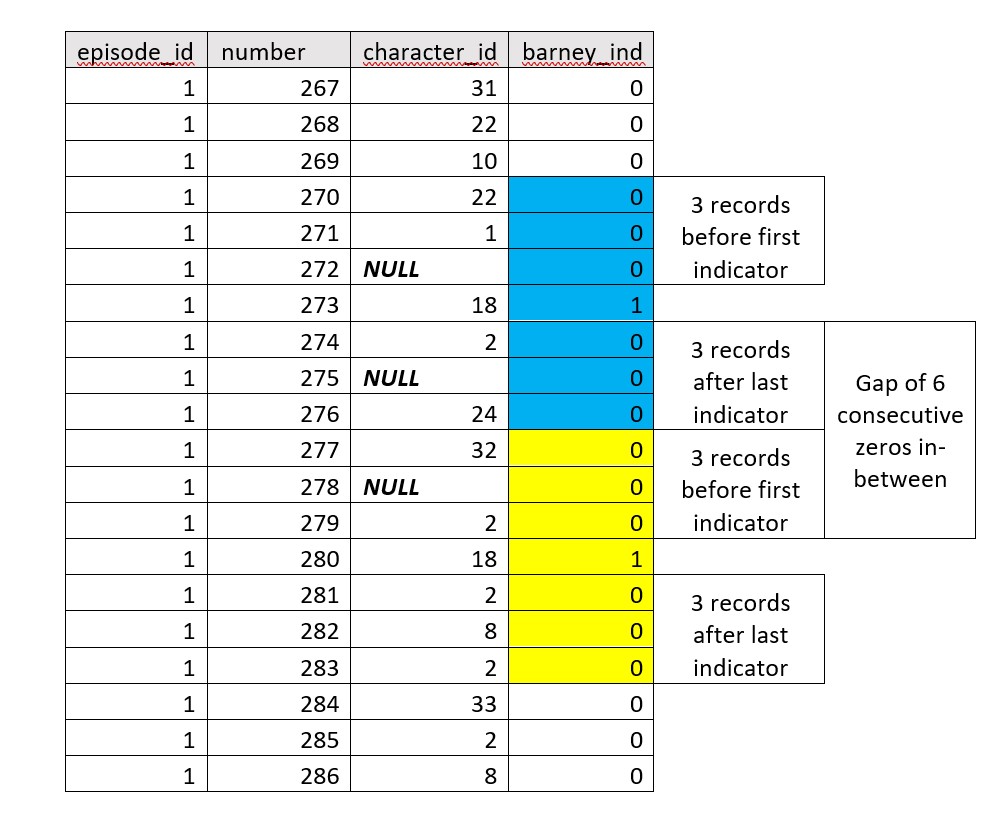
Here, we have a gap of 6 records between two records with “barney_ind” = 1. So, the blue block of records would correspond with 1 “Barney appearance” and the yellow block of records would correspond with a second “Barney appearance.” Again, also note that Homer appears in both of these “Barney appearances.”
Query
WITH tab1 AS
(
SELECT		*,
		CASE
		WHEN	character_id = 18 THEN 1
		ELSE 	0
		END AS 	barney_ind
FROM		script_lines
),
tab2 AS
(
SELECT		*,
		SUM(barney_ind) OVER(ORDER BY episode_id, number) as b_ind_run_sum,
		CASE
		WHEN	(SUM(barney_ind) OVER(	PARTITION BY episode_id
						ORDER BY episode_id,number
						ROWS BETWEEN 3 PRECEDING AND 3 FOLLOWING) > 0) THEN 1
		ELSE	0
		END AS 	b_app_ind
FROM		tab1
),
tab3 AS
(
SELECT		*,
		CASE
		WHEN	(b_app_ind = 1 AND (LAG(b_app_ind) OVER(PARTITION BY episode_id
								ORDER BY episode_id,number) = 0)) THEN 1
		WHEN	(b_app_ind = 1 AND (SUM(barney_ind) OVER(PARTITION BY episode_id
								ORDER BY episode_id,number
								ROWS BETWEEN 3 PRECEDING AND 2 FOLLOWING) = 0)) THEN 1
		ELSE 	0
		END AS 	start_b_app
FROM		tab2
),
tab4 AS
(
SELECT 		*,
		SUM(start_b_app) OVER(ORDER BY episode_id, number) AS barney_groups,
		CASE
		WHEN	character_id = 2 THEN 1
		ELSE 	0
        	END AS 	homer_ind
FROM		tab3
WHERE		b_app_ind = 1
),
tab5 AS
(
SELECT		barney_groups,
		MAX(homer_ind) AS homer_in_b_app
FROM		tab4
GROUP BY 	barney_groups
),
tab6 AS
(
SELECT		CASE
		WHEN 	homer_in_b_app = 1 THEN 'With Homer'
		WHEN 	homer_in_b_app = 0 THEN 'Without Homer'
		ELSE 	NULL
		END AS 	Barney_Appearance
FROM		tab5
)
SELECT		Barney_Appearance,
		COUNT(*) AS App_Count
FROM		tab6
GROUP BY 	Barney_Appearance;
Output
| Barney_Appearance | App_Count |
|---|---|
| With Homer | 215 |
| Without Homer | 111 |